
E1 Climate Change
Decarbonizing our shipping services
Strategy
Transition plan for climate change mitigation
Höegh Autoliners has established two clear strategic targets for decarbonizing its vessel operations. The first is to reduce fleet-wide carbon intensity by more than 30% by 2030, compared to 2019 levels. The second is to achieve net-zero emissions across its vessel operations by 2040. To deliver on these targets, Höegh Autoliners has developed a comprehensive decarbonization plan that incorporates both essential and ambitious measures within its operations and supply chain. This plan is fully integrated into the company’s business strategy and financial planning and was approved by the board as part of the updated decarbonization strategy and ambitions introduced in 2022.
Our net-zero ambitions and decarbonization plan focus on the life-cycle emissions of fuel used in vessel operations* (well-to-wake). We recognise that, to be fully aligned with the ESRS transition plan requirements, the scope of our plan will need to expand over time to cover a broader share of our value‑chain emissions. While the current plan already addresses more than 80% of the value‑chain emissions reported in 2025, we are assessing how best to extend this scope and are also exploring external validation to confirm alignment with the Paris Agreement’s 1.5°C pathway. At the same time, our 2040 net‑zero target places us ahead of the International Maritime Organization’s goal of achieving net‑zero emissions by 2050.
Pathway to Net Zero by 2040 – Two Key Priorities
Höegh Autoliners’ decarbonization strategy is anchored in two key priorities. Firstly, we focus on improving energy efficiency across our existing fleet. While these measures alone will not achieve our net-zero GHG ambition, they are essential for meeting our carbon intensity target by 2030. Secondly, and most critically, we are working to transition our fleet to vessels that are capable of and compatible with the fuel shift required to reach net-zero by 2040.
Further details on the decarbonization actions undertaken during the reporting year are provided in ESRS E1-3 section.

Fleet renewal is, and will remain, a critical enabler for achieving our 2040 net-zero target, as it supports both enhanced energy efficiency and the adoption of alternative fuels. Recognizing the increased uncertainties beyond 2030 – stemming from both internal and external factors – Höegh Autoliners has identified the following two key decarbonization levers to deliver on its 2040 ambition:
Fleet renewal
A substantial renewal of the existing fleet is essential for achieving Höegh Autoliners’ decarbonization targets, as the current vessels cannot operate entirely on near-zero emission fuels. The Company’s ongoing newbuilding program, representing approximately USD 1.5 billion in committed capital expenditure, is a direct contributor to this strategy.
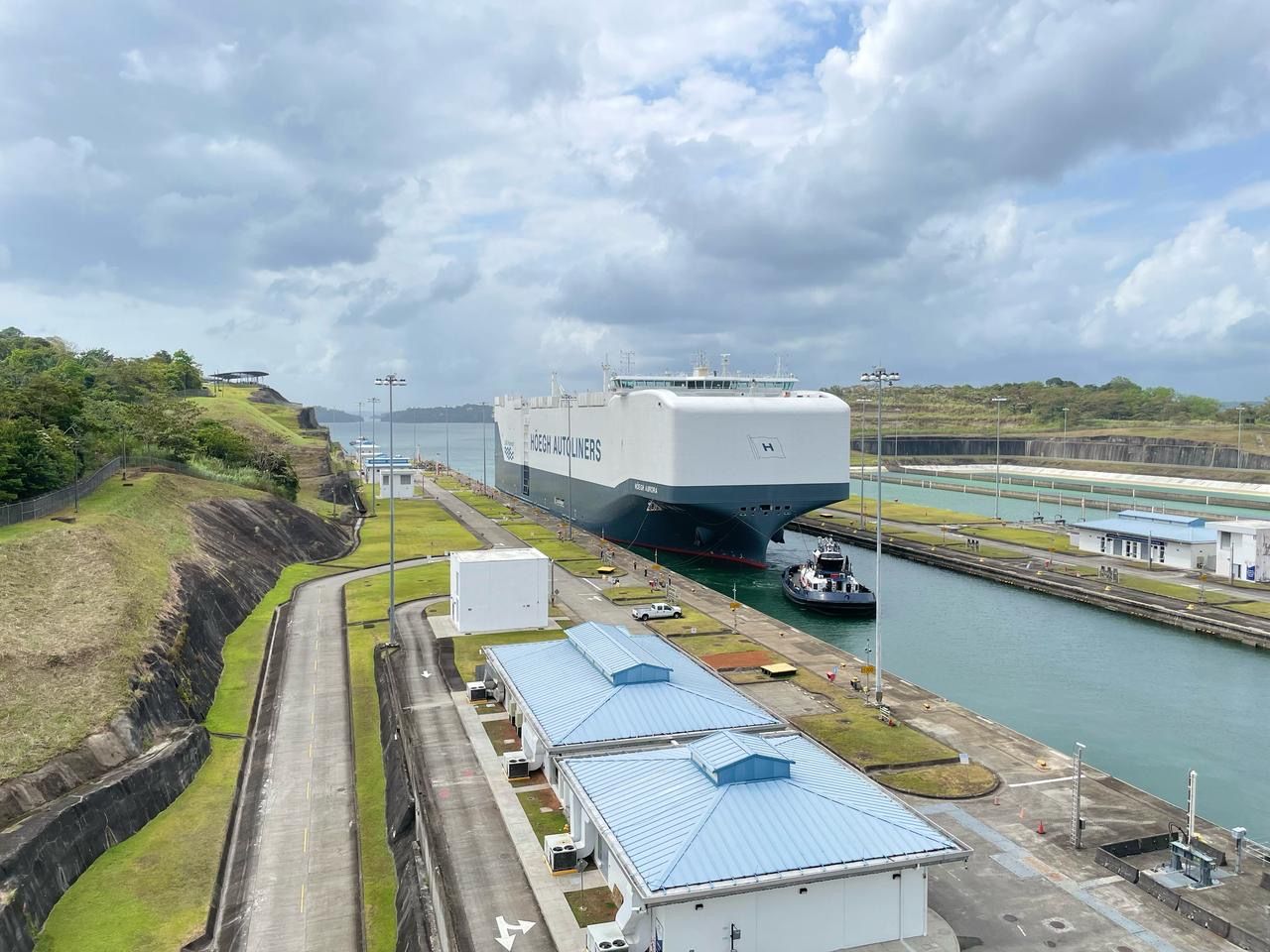
The newbuilding program comprises 12 Aurora-class vessels:
– Vessels 1 – 8 are ammonia-ready and designed for future conversion to ammonia-capable notation.
– Vessels 9 – 12: Delivered as ammonia-capable from inception.
As of the end of the reporting period, seven ammonia-ready vessels have been delivered and are in operation, with vessel number eighth scheduled for delivery in early 2026. The ammonia-capable vessels are expected to be delivered in 2027 and 2028. In addition to these newbuildings, eight vessels from the current fleet are expected to remain in service by 2040 and are eligible for conversion to operate on near-zero emission fuels once commercially viable. Vessels that exceed their expected 30-year operational lifetime are generally considered as candidates for recycling. In line with our decarbonisation plan, all candidate vessels will undergo a thorough assessment prior to any recycling decisions. Fleet replacements will be secured through newbuilds, second‑hand acquisitions, or chartering, ensuring full compatibility with our decarbonisation plan.
Information on eligible and aligned revenues, CapEx, and OpEx is provided in the EU Taxonomy section.
Adoption of alternative fuels
Transitioning to near-zero emission fuels is fundamental to achieving Höegh Autoliners’ net-zero ambition by 2040. The Company is committed to pursue its ambitions of operating its fleet on clean ammonia and other sustainable alternatives, including drop-in fuels such as biodiesel and bio-LNG.
The introduction of ammonia-capable Aurora-class vessels, scheduled for deployment from 2027, represents a significant milestone in demonstrating the technical feasibility of near zero-emission deep-sea shipping. However, large-scale adoption is contingent upon the development of a commercially viable green fuel market, supporting infrastructure, and a global regulatory framework that incentivizes long-term investment in low-carbon technologies.
Höegh Autoliners actively collaborates with fuel producers, regulators, and customers to accelerate the commercialization of green fuels and to establish efficient supply chains. Through its membership in the First Movers Coalition, the Company has committed to operating at least 5% of its deep-sea transport on green fuels by 2030, reinforcing its role as one of the industry leaders in driving the energy transition.
Certain vessels within Höegh Autoliners’ fleet will contribute to locked-in emissions beyond 2040. As of the end of 2025, this primarily relates to eight legacy vessels that cannot operate on near-zero emission fuels, except for the use of biofuels. In addition, the first eight vessels delivered under the current newbuilding program will also generate locked-in emissions after 2040 unless converted to propulsion systems compatible with near-zero emission fuels or operated on biofuels/bioLNG.
Supporting its decarbonisation strategy, Höegh Autoliners integrates sustainability-related performance metrics into management’s short-term incentive scheme. This approach aligns individual performance with corporate objectives and sustainability ambitions, covering both environmental and social dimensions. Further details on the incentive structure are provided in the Remuneration Report available on our website.
Höegh Autoliners is not excluded from the EU Paris-aligned Benchmarks.
Material impacts, risks and opportunities and their interaction with strategy and business model
The double materiality assessment (DMA) process as described in ESRS 2 – IRO-1 identified the following material impacts, risks and opportunities:
Impacts, risks and opportunities (IROs)
| Location in the value chain | Time horizon | ||||||
|---|---|---|---|---|---|---|---|
| Upstream | Own operations | Downstream | Short-term | Medium-term | Long-term | ||
| GHG emissions in own operations | Actual negative impact | ⚫ | ⚫ | ⚫ | ⚫ | ||
| GHG emissions in the value chain | Actual negative impact | ⚫ | ⚫ | ⚫ | ⚫ | ⚫ | |
| Financial consequences of climate change | Financial risks | ⚫ | ⚫ | ⚫ | ⚫ | ⚫ | ⚫ |
| Financial opportunities | ⚫ | ⚫ | ⚫ | ⚫ | |||
Negative impacts on climate change
GHG emissions in own operations
Höegh Autoliners vessel operations produce a significant amount of greenhouse gases from combustion of fuel. These emissions contribute negatively to climate change, which can also have negative effects for human health and other adverse environmental impacts. These impacts are part of its own operations, are systemic to the shipping sector, and are relevant in the short, medium, and long term.
GHG emissions in the value chain
A substantial share of Höegh Autoliners’ greenhouse gas (GHG) emissions arises within the value chain. In addition to operational emissions, vessel construction associated with newbuilding activities represents a significant contributor. While these emissions are not systematically included in the Company’s operational footprint, they occur as a direct consequence of the fleet renewal strategy and are therefore material to the overall decarbonization pathway.
Other major sources of value chain emissions include the extraction, refining, and transportation of fuels used in operations (Scope 3, Category 3), as well as emissions from purchased goods and services. These emissions are considered systemic to the industry and is relevant across all time horizons.
Furthermore, end-of-life recycling of vessels reaching the end of their technical lifetime is expected to become more relevant over the coming years, as recycling activity is expected to accelerate in line with the aging profile of the fleet.
Financial consequences of climate change
Transitional climate risks
The risks identified through the DMA are consolidated in the IROs table above. This table highlights that certain financial risks extend across all time horizons. Each material risk is further disaggregated and described in detail in the sections below.
-
Regulatory uncertainty and external sentiment
Uncertainty in global decarbonization regulations and policies represents a financial and strategic transitional risk for Höegh Autoliners. This uncertainty may affect our ability to decarbonize shipping operations at a pace aligned with stakeholder expectations, including customers, investors, regulators, and financial institutions. Achieving our decarbonization targets depends on global regulatory frameworks that ensure a level playing field and incentivize alternative fuels until they become commercially viable. Mechanisms such as global carbon taxes, common decarbonisation frameworks, and/or contracts for differences are critical to enable this transition. Without a well-functioning market for decarbonization solutions, there is a risk that customers may opt out of decarbonization efforts, making it financially unsustainable to fully execute our strategy. These risks are relevant over the short, medium and long term.
-
Propulsion technology and CapEx needs
Höegh Autoliners has secured access to four dual-fuel ammonia engines, enabling vessels 9 – 12 in the current newbuilding program to operate on ammonia from delivery. While this represents a significant step toward a net-zero capable fleet, investment decisions for assets with an expected lifetime of approximately 30 years carry inherent risks. The choice of propulsion technology remains a critical uncertainty over the medium and long term, given evolving fuel availability, infrastructure development, and regulatory frameworks.
Executing the Company’s decarbonization strategy will require substantial capital and operational expenses. Beyond the ongoing newbuilding program, additional CapEx will be necessary for technical upgrades to the existing fleet and future acquisitions of net-zero capable vessels, whether through newbuilds or the second-hand market. Operational expenditures are also expected to rise due to higher costs for alternative fuels, carbon pricing mechanisms, compliance requirements, and the training and upskilling of crew. These financial risks are relevant across short-, medium-, and long-term horizons.
Opportunity
-
Being a first mover can position the company as the preferred green shipping partner for decarbonizing customers’ supply chains
The ongoing fleet transition presents an opportunity not only to achieve low greenhouse gas emissions and comply with upcoming regulations, but also to demonstrate strong leadership. This can position ourselves as the preferred green shipping partner for our customers, supporting them in decarbonizing their supply chains. This opportunity is relevant over the short, medium, and long term.

Impact, risk and opportunity management
Policies related to climate change mitigation and adaptation
IMO regulations serve as clear guidelines for policy development within Höegh Autoliners. By implementing policies reflecting our vision of a near-zero emission future for shipping, through fleet transition and adoption of alternative fuels, we establish a clear direction for our decarbonisation strategy.
“Höegh Autoliners’ Environmental Policy” prioritizes managing and reducing our environmental footprint by continuously improving performance in areas like decarbonization and renewable energy use. It outlines initiatives to reduce emissions across our value chain, foster innovation and research and engage stakeholders. The policy applies to all subsidiaries, with the Chief Executive Officer bearing ultimate responsibility for oversight.
The “Environmental Focus Plan” is an annual plan that describes our efforts on various environmental topics throughout the year, assigning detailed initiatives to each area. This plan was developed to enhance awareness of the environmental footprint of our vessel operations and to foster a safe and inclusive working environment. It sets clear objectives, targets, and actions for relevant environmental topics, with a particular focus on reducing GHG emissions and the consumption of non-renewable resources. Policy development and implementation are overseen and approved by the Chief Operations Officer, with the leaders in the Operations department responsible for driving the processes and initiatives, such as the Head of Höegh Technical Management, holding the fleet responsibility for compliance with the International Safety Management (ISM) code.
Höegh Autoliners’ “Supplier Code of Conduct (SCC)” sets forth environmental requirements across Höegh Autoliners’ supply chain. This includes a commitment to best practices in environmental management, sustainability, and energy and resource efficiency. The SCC is overseen by the Chief Executive Officer and applies to all suppliers and subcontractors. Further details about SCC are provided in ESRS G1-1
All policies mentioned above are available to all employees through our internal intranet.
Actions and resources in relation to climate change policies
Höegh Autoliners focuses on two main areas for decarbonizing its shipping services: first, enhancing energy efficiency in our existing fleet and second, fleet transition, including the uptake of alternative fuels. To support the objectives and targets of our climate-related policies, we have implemented the following actions in accordance with our fleet wide Ship Energy Efficiency Management Plans (SEEMPs):
Enhancing energy efficiency in our existing fleet
Höegh Autoliners continues to follow up on its planned initiatives or technical upgrades, which are fully aligned with its long-term efforts to increase energy efficiency of the existing fleet.
The following upgrades have been installed in 2025:
- New propellers were installed on 2 vessels. These propellers are customized to meet our operational requirements and are designed to enhance hydrodynamic efficiency through their integrated propulsive unit. Depending on trading pattern and speed, it is expected that they will deliver 3-6% fuel savings annually per vessel.
- Propeller boss cap fins have been retrofitted to 3 vessels. The installation is designed to improve propeller efficiency by reducing wasted energy behind the propeller (reduce hub vortex losses), helping the vessel use less fuel overall. The expected annual fuel savings is around 2-2.5% per vessel.
- Turbocharger modifications have been completed on 3 vessels this year. These modifications aim to increase the vessels’ speed range, allowing for reduced fuel consumption while maintaining the same operational speeds. It is expected that the initiative will present 2-3% fuel savings annually per vessel depending on the operational profile of the vessels.
- eMarine variable frequency drives have been installed on 4 vessels. The aim is to ensure that pumps and ventilation fans operate at optimal frequency and power levels, with the aim to yield fuel savings of up to 2% annually.
- A digital data‑analytics and monitoring platform has been installed on six vessels to enhance operational efficiency, reliability, and environmental performance, and is expected to deliver around 1% fuel savings per vessel by providing deeper insights into real‑time operational conditions.
- In 2025, Höegh Autoliners allocated approximately MUSD 4.5 in CapEx for technical upgrades. We expect to invest an additional MUSD 6.5 in similar initiatives in 2026.
Additionally, other important initiatives related to energy efficiency is hull cleaning and vessel maintenance. This is performed for all operating vessels on a regular basis. With the same cleaning and maintenance plan year over year, the annual efficiency improvement is limited. However, the outcome of a hull cleaning improves energy efficiency by reducing drag and optimizing the vessel’s performance. It is expected that each hull cleaning contributes with 3-5% fuel savings when comparing consumption before and after cleaning.
- The implemented digital trim monitoring system optimises vessels’ trim in the water. By adjusting the trim based on real-time data, this reduces water resistance, leading to reductions in fuel consumption. This initiative is expected to yield 1% in fuel savings annually per vessel.
- Höegh Autoliners has taken delivery of approximately 8,400 metric tons of ISCC-certified sustainable biofuel (B100) this year. These deliveries contribute to reduced GHG emissions of around 26,000 metric tons of CO2 equivalents.
- We have signed several LOIs with partners across the clean‑ammonia value chain and strengthened our relationships with selected prospective producers in Europe and Asia to secure future supply. These collaborations support innovation and help accelerate the adoption of clean ammonia as a viable alternative fuel, which can reduce the life‑cycle emissions of our fuel by at least 70%.

Fleet transition, and uptake of alternative fuels
Reaching our decarbonisation goals requires a substantial transition of our fleet. This includes the addition of near zero-emission capable vessels, phase-out of legacy tonnage and the uptake of alternative fuels.
Introduction of Aurora Class Vessels
In 2025, Höegh Autoliners took delivery of three additional Aurora-class newbuildings – Höegh Moonlight, Höegh Sunrise, and Höegh Starlight – bringing the total to seven LNG dual-fuel vessels delivered under our twelve-vessel newbuilding program as of period end.

Key features of the Aurora Class:
Aurora Class vessels are equipped with DNV’s “ammonia ready” notation and have a capacity of 9,100 CEU.
The first 8 vessels of the newbuilding program have been and will be delivered with LNG dual-fuel engines, which have the potential to reduce carbon emissions per car transported by up to 58% when compared to the industry standard PCTC vessel running on fuel oil/diesel. Additionally, they can connect to shore power for emissions-free port operations.
In 2026, Höegh Autoliners is set to take delivery of one additional LNG dual-fuel vessel, with delivery scheduled in Q1 of 2026.
Höegh Autoliners has continued its work to have vessels number 9-12 in the newbuilding program delivered with ammonia dual-fuel engines, with the first vessel scheduled to be delivered in 2027. The engines have been confirmed from Everllence (previously MAN Energy Solution), enabling these vessels to run on clean ammonia with near zero carbon emissions when delivered from the yard.
Three ammonia dual-fuel vessels are expected to be delivered in 2027, with the final vessel delivered in 2028. All vessels of the newbuilding program are expected to be delivered by 2028.
Investments related to the Aurora Class vessels:
In 2025, Höegh Autoliners paid approximately MUSD 231 (2024: MUSD 357) in CapEx instalments related to the newbuilding program. By the end of 2025, the remaining CapEx for the project is estimated at USD 493 million, with USD 459 million expected to come from secured debt drawdowns and USD 34 million from equity. The total investment/commitment for the entire newbuilding program is estimated to be around USD 1.5 billion as of period end. Milestone payments are capitalized as part of additions to newbuildings (please refer to note 7 in the financial statements).
In early 2024, the group linked MUSD 720 in long-term corporate financing to its decarbonization strategy through a sustainability-linked loan. The financing framework and its emissions trajectory, verified by DNV through a second-party opinion (SPO), is aligned with our 2030 carbon intensity reduction target. We measure and monitor carbon intensity development quarterly and obtain annual verification of the KPI as part of our loan agreement obligations. Four of the Aurora Class vessels are and will be pledged in the loan when delivered, while the remaining eight will be financed through sale-leaseback arrangements upon delivery.
Phase-out legacy tonnage
In 2025, Höegh Autoliners sold and delivered two vessels (2024:two) to their new owners, Höegh New York (2005 built), and Höegh Beijing (2010 built). With the continued introduction of the Aurora Class vessels to the fleet, the company used this opportunity to optimize its fleet from both commercial and sustainability perspectives. The vessel sales are anticipated to have a contribute positively to achieving the decarbonisation targets.
Vessels that exceed their expected lifetime of 30 years are generally considered as candidates for recycling. In line with our decarbonisation plan, all candidate vessels will undergo a thorough assessment before any recycling decisions are made.
Going forward, Höegh Autoliners continues to be strongly committed to achieving its decarbonisation targets and will continue to explore innovative ways and new partnerships to optimize its current energy efficiency, and to further reduce their environmental footprint.

Metrics and targets
Targets related to climate change mitigation and adaptation
Höegh Autoliners has integrated two overarching climate-related targets into its corporate strategy, being the “30 by 30” target for short-to medium term carbon intensity reduction, and the “0 by 40” target for achieving net-zero emissions by 2040 as further detailed below.
For the short-to medium term, Höegh Autoliners has set a target with the aim to reduce fleet carbon intensity by more than 30% by 2030, using a 2019 baseline. This is an intensity target. The scope includes all vessels owned or technically managed by the Höegh Group. We have selected 2019 as the baseline year because it is the most recent full year with available global GHG emissions data under normal operations, verified by externally audited IMO DCS data. Please refer to Entity-Specific metric (Carbon-Intensity) below for more details.
Höegh Autoliners has set a target to reach net-zero in vessel operations by 2040. This target is an absolute target. The scope covers all vessels operated by the Group in the reporting year and includes the life cycle emission of fuels consumed (scope 1, and scope 3 (Category 3)). We have set 2023 as the base year for our net-zero ambition, as it marks the first year where we reported a complete carbon inventory across all scopes and calculated Scope 1 and Scope 3 (Category 3) emissions using our current methodology.
Both targets are not based on conclusive scientific evidence. They support our operational policies and procedures by addressing climate-related impacts, managing associated risks and opportunities, and ensuring compliance with global regulatory requirements, including IMOs decarbonisation strategy.
Energy consumption and mix
In 2025, total energy consumption increased by 9.2%, driven by a higher number of vessels in operation during the year and the corresponding rise in fuel consumption.
Energy consumption
| Unit | 2025 | 20241 | |
| 1. Fuel consumption from coal and coal products | GWh | - | - |
| 2. Fuel consumption from crude oils and petroleum products | GWh | 3 342 | 3 416 |
| 3. Fuel consumption from natural gas | GWh | 283 | 27 |
| 4. Fuel consumption from other fossil sources (Marine diesel oil) | GWh | 712 | 516 |
| 5. Consumption of purchased or acquired electricity, heat, steam, and cooling from fossil sources | GWh | 1 | 1 |
| 6. Energy consumption from fossil sources (sum of 1 to 5) | GWh | 4 338 | 3 960 |
| 7. Consumption from nuclear sources | GWh | - | - |
| 8. Fuel consumption for renewable sources | GWh | 84 | 88 |
| 9. Consumption of purchased or acquired electricity, heat steam and cooling from renewable sources | GWh | - | - |
| 10. Self-generated non-fuel renewable energy | GWh | - | - |
| 11. Energy consumption from renewable sources (sum of 8 to 10) | GWh | 84 | 88 |
| TOTAL ENERGY CONSUMPTION (sum 6, 7 and 11) | GWh | 4 422 | 4 049 |
| 1 2024 energy data has been restated due to an improved energy calculation methodology. | |||
|---|---|---|---|
Accounting Policies - Energy consumption and mix
Metrics reported in this section are not validated by an external body other than the assurance provider.
Consolidation: Energy consumption data is collected and consolidated by fuel type and reported in GWh, in accordance with IMO guidelines for energy‑consumption calculations. Fuel consumption is converted to energy (MJ) using the default lower calorific value (LCV) for each fuel provided by the IMO. The resulting MJ figures are then converted to GWh by multiplying by 0.2778 and dividing by 1,000,000.
Total energy consumption from fossil sources: Energy consumption from fossil sources includes fossil-based energy used in Höegh Autoliners operations. This includes fuel oil, marine diesel oil, liquified natural gas (LNG), and the consumption of purchased or acquired electricity, heat, steam, and cooling derived from fossil sources.
Total energy consumption from renewable sources: Energy consumption from renewable sources represents Höegh Autoliners consumption of biofuels.
Restatement of prior‑period information: A methodological improvement has been made in the calculation of energy consumption from fuel combustion onboard vessels. Comparative information has been updated to ensure consistency across reporting periods.
The restatement affects the following KPIs under E1-5:
- Energy consumption from fuel combustion onboard vessels
Energy intensity
Due to Höegh Autoliners’ activities being classified as a high climate impact sector (NACE code H50.2) under the Commission Delegated Regulation (EU) 2022/1288, we are presenting our energy intensity and mix below.
Energy intensity based on revenue
| Unit | 2025 | 2024 2 | |
|---|---|---|---|
| Energy intensity 1 | GWh/USDm | 3.10 | 2.95 |
| Share of fossil fuel sources in energy consuption | % | 98% | 98% |
| Share of renewable energy consumption 2 | % | 2% | 2% |
| Share of consumption from nuclear sources in total energy consumption | % | 0% | 0% |
| 1 Net revenue is reported in Note 2 - Financial statement. All of Höegh Energy consumption is considered as related to high climate impact sectors. 2 2024 energy data has been restated due to an improved energy calculation methodology. | |||
Accounting Policies - Energy intensity and mix
Metrics reported in this section are not validated by an external body other than the assurance provider.
Consolidation: Energy intensity refers to the ratio of total energy consumption to net revenue. The net revenue used in this calculation is detailed in Note 2 of the financial statements. All energy consumption is originating from sectors with high climate impact, as per (EC) No 1893/2006 (segments significantly contributing to GHG emissions due to its activities).
Energy intensity: Energy intensity refers to the ratio of total energy consumption to net revenue. The net revenue used in this calculation is detailed in Note 2 of the financial statements. All energy consumption is originating from sectors with high climate impact, as per (EC) No 1893/2006 (segments significantly contributing to GHG emissions due to its activities).
Restatement of prior‑period information: A methodological improvement has been made in the calculation of energy consumption from fuel combustion onboard vessels. Comparative information has been updated to ensure consistency across reporting periods.
The restatement affects the following KPIs under E1-5:
- Energy intensity based on revenue
Gross Scopes 1, 2, 3 and Total GHG emissions
In 2025, Höegh Autoliners’ total emissions decreased by 15% compared to 2024. The Year‑over‑year improvements in GHG emission are primarily driven by substantially lower reported emissions from our newbuilding program. These emissions are recognized in line with instalment schedules, and the timing of milestones in 2025 resulted in reduced newbuilding-related emissions. These effects were partly offset by increased Scope 1 emissions from operating a larger fleet in 2025 compared to 2024.
Gross scopes 1, 2, 3 and total GHG emissions
| Retrospective | Milestones and target years | |||||||
|---|---|---|---|---|---|---|---|---|
| Base year (2023) | 2024 | 2025 | % 2025 /2024 | 2025 | 2030 | 2040 | Annual % target/Base year | |
| Scope 1 GHG emissions | ||||||||
| Gross Scope 1 GHG emissions (tCO2eq) | 1 103 090 | 1 114 732 | 1 214 587 | 9% | N/A | N/A | 96% | N/A |
| Percentage of Scope 1 GHG emissions from regulated emissions trading schemes (%) | N/A | 15% | 12% | -20% | N/A | N/A | N/A | N/A |
| Scope 2 GHG emissions | ||||||||
| Gross location-based Scope 2 GHG emissions (tCO2eq) | N/A | 463 | 455 | -2% | N/A | N/A | N/A | N/A |
| Gross market-based Scope 2 GHG emissions (tCO2eq) | N/A | 478 | 736 | 54% | N/A | N/A | N/A | N/A |
| Significant Scope 3 GHG emissions | ||||||||
| Total Gross indirect (Scope 3) GHG emissions (tCO2eq) | N/A | 971 002 | 563 893 | -72% | N/A | N/A | N/A | N/A |
| 1) Purchase goods and services | N/A | 86 355 | 83 099 | -4% | N/A | N/A | N/A | N/A |
| 2) Capital goods | N/A | 598 620 | 151 360 | -75% | N/A | N/A | N/A | N/A |
| 3) Fuel and energy-related activities (not included in Scope 1 or Scope 2) | 240 076 | 241 265 | 266 404 | 10% | N/A | N/A | 90% | N/A |
| 4) Upstream transportation and distribution | N/A | 42 140 | 60 830 | 44% | N/A | N/A | N/A | N/A |
| 6) Business travels | N/A | 2 622 | 2 200 | -16% | N/A | N/A | N/A | N/A |
| Total GHG emissions | ||||||||
| Total GHG emissions (location-based) (tCO2eq) | N/A | 2 086 198 | 1 778 934 | -15% | N/A | N/A | N/A | N/A |
| Total GHG emissions (market-based) (tCO2eq) | N/A | 2 086 212 | 1 779 215 | -15% | N/A | N/A | N/A | N/A |
| In 2025, upstream and distribution emissions were reclassified from Category 1 to Category 4, and 2024 figures have been restated for comparability. | ||||||||
Accounting Policies - Gross scopes 1, 2, 3 and total GHG emissions
Metrics reported in this section are not fully validated by an external body other than the assurance provider.
Consolidation: Emissions reporting follows the Greenhouse Gas Protocol and relevant ISO standards covering:
• Direct emissions from fuel combustion in our operations (Scope 1)
• Emissions related to electricity consumption (Scope 2)
• Indirect emissions throughout our value chain (Scope 3)
GHG emissions data are presented in CO2 equivalents (CO2eq) and include all operating vessels for the calendar year (January 1 to December 31, 2025). Consumption data for vessels under the ISM responsibility of the Höegh Autoliners Group is verified by the class society, adding an additional layer of quality assurance.
EMISSION CALCULATIONS:
The GHG emissions calculations use relevant emission factors related to fuel and energy consumption. These factors are in accordance with the Intergovernmental Panel on Climate Change (IPCC) Sixth Assessment Report (AR6, 2022), the Exiobase database, and the Third and Fourth IMO GHG Studies (2020).
Gross scope 1 emissions:
• Gross Scope 1 emissions includes the sum of CO2, CH4, N2O, and HFC gases, all converted into CO2 equivalents. CO2, CH4 and N2O emissions are calculated based on fuel consumption. HFCs is calculated based on the reported consumption of refrigerants.
• Percentage of Scope 1 GHG emissions from regulated emissions trading schemes (%): this represents the proportion of Gross Scope 1 GHG emissions covered by the EU Emissions Trading System (EU ETS).
Gross location-based scope 2 emissions:
• Gross location-based Scope 2 emissions include CO2 equivalents from electricity consumption in all Höegh Autoliners office locations, based on relevant location-based emission factors obtained from a third-party source. Electricity consumption in agent offices is not included in this consolidation.
Gross market-based Scope 2 emissions:
• Gross market-based Scope 2 emissions include CO2 equivalents from electricity consumption in all Höegh Autoliners office locations, based on relevant market-based emission factors obtained from a third-party source. A residual mix factor is used, adjusted for any green certificate purchase. Electricity consumption in agent offices is not included in this consolidation.
Accounting Policies - Gross scopes 1, 2, 3 and total GHG emissions - continued
Gross Scope 3 emissions:
Gross Scope 3 Emissions include indirect emissions from Höegh Autoliners' value chain activities, both upstream and downstream. The GHG Protocol divides Scope 3 emissions into 15 categories. Based on our Scope 3 mapping, four categories are considered material, all related to upstream activities. Last year, two additional categories (5: Waste generated in operations and 7: Employee commuting) were calculated but found to be insignificant. We will continue to closely monitor and assess whether additional categories should be included in our reporting going forward.
Excluded from the emissions reporting are the following categories:
• Category 5 - Waste generated in operations. Emissions derived from waste generated in operations were evaluated and considered to be insignificant for the 2025 reporting. It is therefore scoped out of this year’s emissions reporting.
• Category 7 – Employee commuting. Emissions derived from employee commuting were evaluated and considered to be insignificant for the 2025 reporting. Therefore, it was scoped out of this year’s emissions reporting.
• Category 8 – Upstream leased assets. Emissions from upstream leased assets are covered in scope 1 (Leased vessels), scope 3 (category 3) and scope 2 (electricity from leased office facilities).
• Category 9 – Downstream transportation and distribution. We do not produce products requiring downstream transportation and distribution.
• Category 10 – Processing of sold products. We are not involved with selling any goods.
• Category 11 – Use of sold products. We are not involved with selling any goods.
• Category 12 – End-of-life treatment of sold products. This category will remain ‘not applicable’ until we report vessels scheduled to recycling.
• Category 13 – Downstream leased assets. We are not leasing any assets to any third parties.
• Category 14 – Franchises. We are not involved with any franchises.
• Category 15 – Investments. We are not involved with any investments.
Total GHG emissions: The total of gross Scope 1 emissions, gross Scope 2 emissions (both location-based and market-based methods), and gross Scope 3 emissions.
GHG Intensity
GHG emission intensity improved in 2025 primarily driven by lower newbuilding-related emissions and higher revenues. These effects were partly offset by increased Scope 1 emissions from operating a larger fleet in 2025 compared to 2024.
GHG emission intensity
| Unit | 2025 | 2024 | |
| Total GHG emission intensity - location based per net revenue | 1,000 tCO2eq/USDm 1 | 1.25 | 1.51 |
| Total GHG emission intensity - market based per net revenue | 1,000 tCO2eq/USDm 1 | 1.25 | 1.51 |
| 1 Net revenue is reported in Note 2 - financial statements | |||
|---|---|---|---|
Accounting Policies - GHG Intensity
GHG intensity: GHG intensity is calculated as the sum of gross Scope 1, Scope 2 (using the location-based approach), and Scope 3 emissions, reported as thousand tons of CO2 equivalents per USDm of net revenue. The net revenue used in this calculation is detailed in Note 2 of the financial statements.
Entity specific metric (Carbon intensity)
Höegh Autoliners’ short-term decarbonisation target is to reduce carbon intensity by more than 30% by 2030, using 2019 as the base year. To track performance against this target, we use the IMO’s Carbon Intensity Indicator (CII), specifically the “capacity gross ton distance” (cgDIST).
The base year was chosen as it represents the most recent full year with available global GHG emissions data under normal operations, externally verified through IMO DCS emission data.
In 2025, the cgDIST was 4.45, compared to 4.98 in 2024. This reflects a reduction of nearly 20% from 2019 levels. The improvement is primarily attributable to energy efficiency initiatives, including technical upgrades, optimization of our trading network, introduction of the use of biofuels, and the initial phase of our fleet renewal program. This program has involved sales of older vessels and the introduction of seven Aurora-class vessels, which deliver significant enhancements in energy efficiency.
| Unit | 2025 | 2024 | 2023 | 2022 | 2021 | 2020 | 2019 | |
| Capacity gross ton distance (cgDIST) | gCO2/(nm*GT) | 4.45 | 4.98 | 5.15 | 5.13 | 5.26 | 5.07 | 5.53 |
The trajectory towards 2030 is expected to remain steep in the coming years, supported by the delivery of five additional Aurora‑class vessels, the last four of which will be capable of operating on ammonia.
Accounting Policies - Carbon Intensity Indicator (CII)
Carbon intensity indicator (CII): The carbon intensity is measured according to the IMO CII definition, which is the “capacity gross ton distance (cgDIST)”. It is calculated as gCO2/(GT*nm). This metric is annually validated by an external party as part of our loan agreement obligations.
Anticipated financial effects from material physical and transition risks and potential climate-related opportunities
Höegh Autoliners exercises its right, under the ESRS Phase-in allowances, to report on the anticipated financial effects from material physical and transition risks and potential climate-related opportunities, if any, from year 3.
